
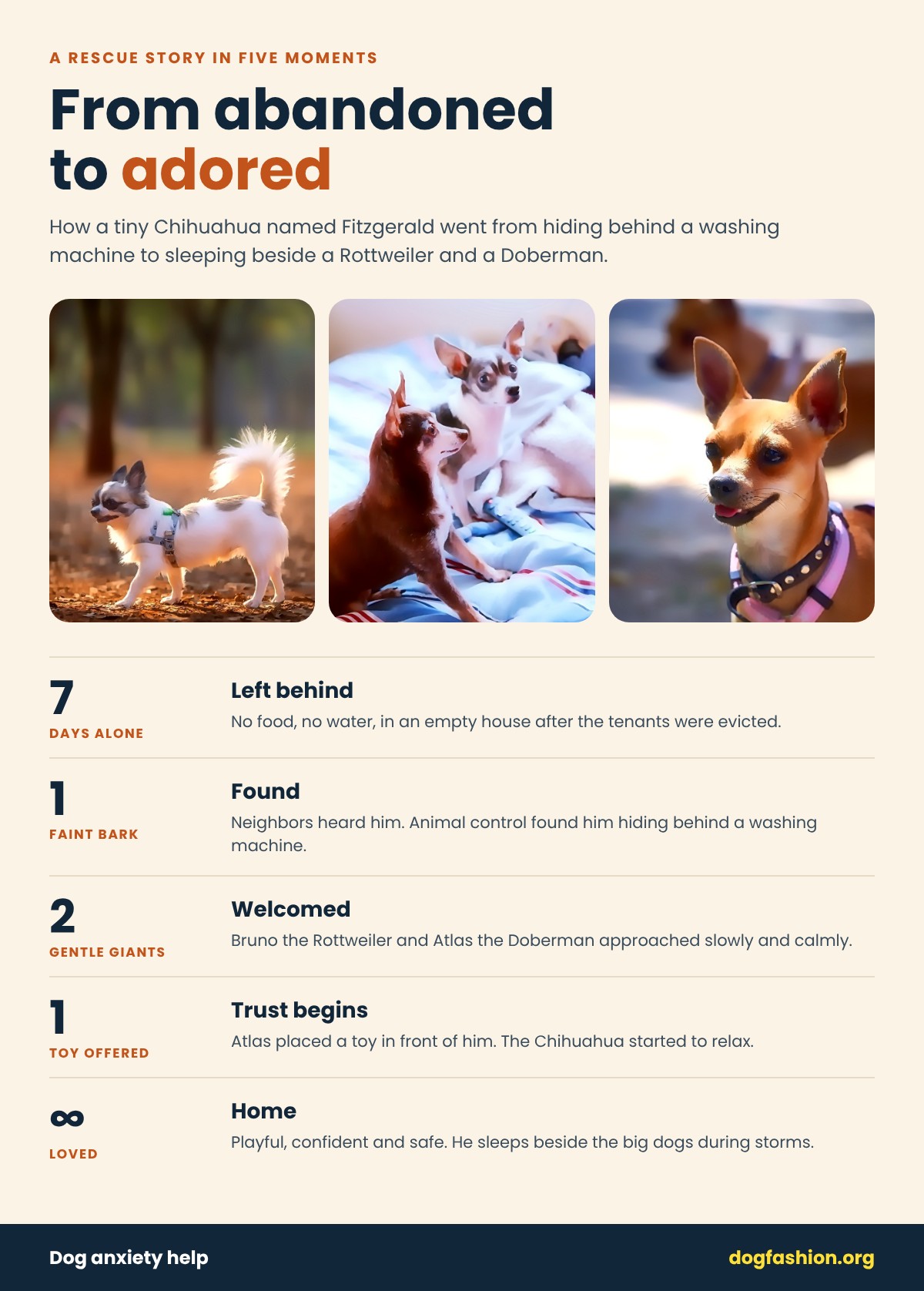
A tiny Chihuahua was found abandoned inside a dirty, empty house after the tenants were evicted. He had no food and no water, and he had been alone for about a week. This is the story of how that frightened little dog became Fitzgerald, and of the two very large dogs who helped him feel safe again. It is also a practical guide to rescue dog anxiety: what fear looks like in an abandoned dog, and what a calm home can do about it.
Scan the code above with your phone camera, or tap here to see the pet hair brush. It is an Amazon affiliate link, so dogfashion.org may earn a small commission at no extra cost to you. We explain further down why gentle brushing belongs in a calming routine for an anxious dog.
Watch: Fitzgerald’s rescue story in 90 seconds
Left behind: a week alone in an empty house
When the tenants were evicted, the house was cleared of people but not of its smallest resident. The Chihuahua stayed behind in rooms that were dirty and bare. For roughly seven days there was nobody to fill a bowl, open a door or say his name.
A week is a very long time for a dog that weighs only a few pounds. Small dogs have little in reserve, and they lose strength quickly without food and water. By the time anyone knew he was there, he was very weak, scared and clearly neglected.
Abandonment after a move or an eviction is sadly common, and it is not limited to one breed. We have told a similar story before, about an abandoned white Pitbull puppy found in a parking lot. The details change, but the pattern is the same: a dog who did nothing wrong is suddenly on his own.
The faint barking that saved him
Fitzgerald was saved because neighbors paid attention. They heard faint barking coming from a house that was supposed to be empty, and they did not ignore it. Animal control came out and searched the property.
They found him hiding behind a washing machine. That detail matters. A frightened dog does not run to strangers for help. He squeezes into the smallest, darkest gap he can find and stays there. Hiding is one of the clearest signs of fear in dogs, and it is often the first thing rescuers and foster families see.
If you ever hear a dog barking or crying from a property you believe is empty, call your local animal control or a rescue group. Do not assume somebody else already has. In this story, one phone call was the difference between a dog who was found and a dog who was not.
A foster home with two gentle giants
A rescue contacted a foster family and asked them to take him in. The family said yes, but they had a real worry. Their home already had two large dogs: a Rottweiler named Bruno and a Doberman named Atlas.
The Chihuahua was extremely small and fragile. Either of the big dogs could have hurt him without meaning to, simply by playing too roughly or stepping in the wrong place. Size differences like this deserve respect, and the family was right to be careful.
When he arrived he was very frightened and barely moved. He did not explore. He did not wag. He stayed still, the way a dog does when he has decided that the safest thing is to be invisible.
The toy that changed everything
What happened next surprised everyone. The large dogs reacted gently and calmly instead of aggressively. Bruno and Atlas approached him carefully, without rushing and without scaring him.
Then Atlas did something small that meant a great deal. He placed a toy in front of the Chihuahua, as if he were offering friendship. Nobody can say exactly what a dog intends, but the effect was clear. The little dog slowly began to relax and, for the first time since he was found, to show trust.
He was named Fitzgerald, a name chosen to reflect his strength and his survival. It is a big name for a small dog, and he grew into it.
How to introduce a small rescue dog to large dogs
Fitzgerald’s introduction went well partly because of who Bruno and Atlas are, and partly because the humans managed it sensibly. If you are bringing a small or nervous rescue into a home with bigger dogs, these steps lower the risk:
- Start with distance. Let the dogs see and smell each other across a room or through a gate before they share space.
- Keep the first meetings short. A few calm minutes are worth more than one long, tense hour.
- Watch the bigger dog’s body. Loose muscles, soft eyes and slow movement are good signs. Staring, stiffness or fixation mean stop and try again later.
- Give the small dog an exit. A crate, a covered bed or a gated corner that the large dogs cannot enter.
- Feed separately. Food is the most common trigger for trouble between dogs who are still strangers.
- Supervise every interaction until you have seen weeks of relaxed behavior, and never leave a toy-sized dog alone with large dogs early on.
Calm, steady dogs make this far easier. If you are curious about temperament in bigger breeds living indoors, our piece on whether Labrador Retrievers make good inside dogs tells a similar adoption story from the large-dog side.
What anxiety looks like in an abandoned dog
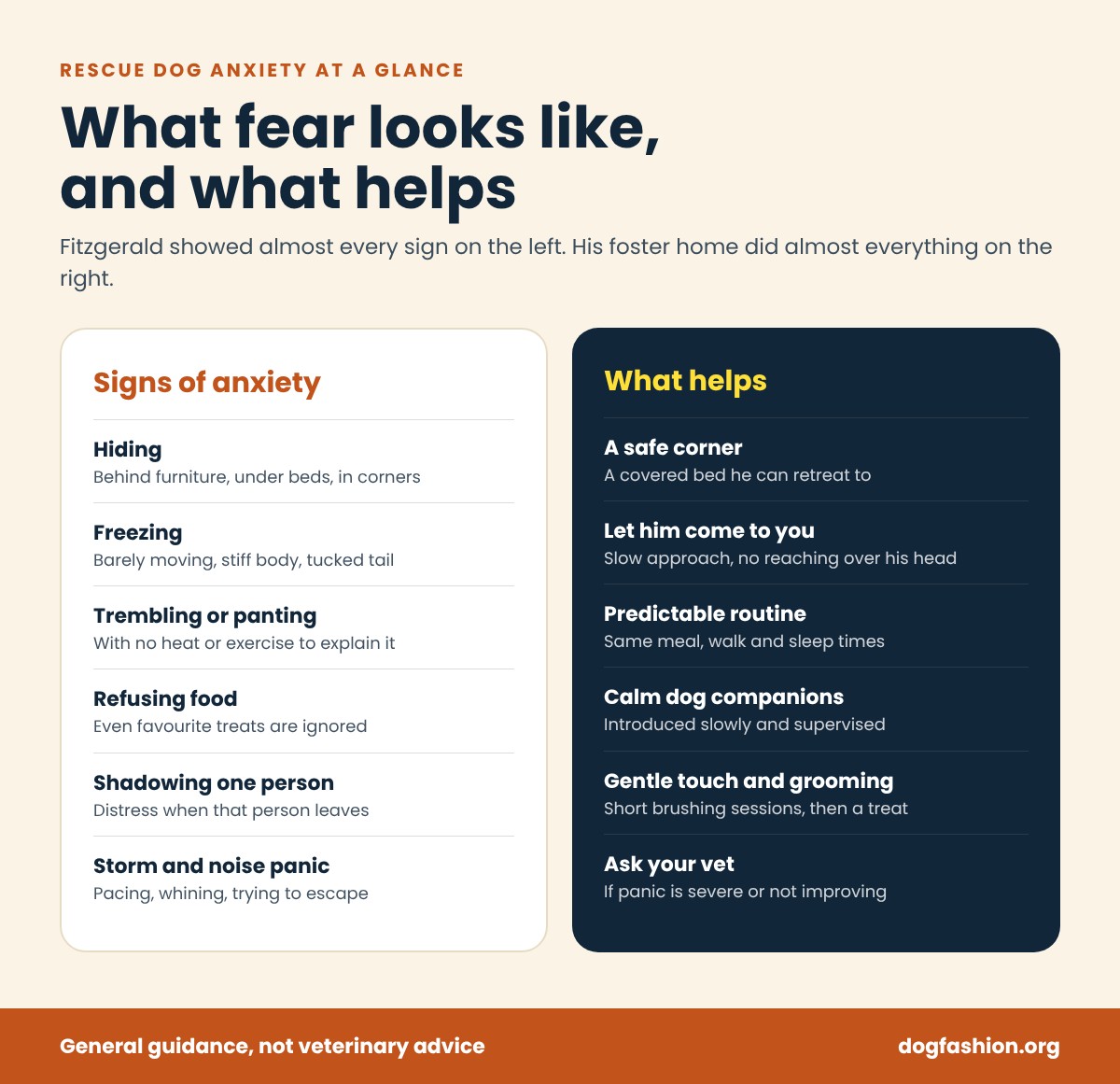
Fitzgerald showed many of the classic signs of dog anxiety in his first days. He hid. He froze. He was too stressed to behave like a normal, curious dog. Other common signs in rescue dogs include trembling, panting with no obvious cause, refusing food, pacing, whining, and following one person so closely that any separation causes distress.
None of this means a dog is broken or badly behaved. As we explain in why your dog’s fear isn’t weakness, fear is information. It tells you what the dog has learned about the world so far, and it can be unlearned with patience.
Sometimes anxiety escalates. A dog who is drooling, trying to escape, injuring himself or unable to settle for hours needs more than a quiet corner. Our guide to the warning signs that pet anxiety is turning into panic covers when to call your veterinarian, and that is always the right call if you are unsure.
From shadow to family member
Over time, Fitzgerald became very attached to his new family. He followed his foster parent everywhere and felt safest when he was close to them. Rescue workers sometimes call these dogs “velcro dogs”, and it is easy to understand why a dog who was once left behind would want to keep his people in sight.
That closeness is touching, but it can tip into separation anxiety if the dog never learns that being alone is safe too. Short, calm absences that slowly get longer are the usual approach, and we go through the method step by step in our article on separation anxiety and gentle training.
The big dogs did their part as well. Bruno and Atlas accepted and protected Fitzgerald like a member of the family. He often slept with them, tucked against a dog many times his size, and he used them for comfort during storms. A calm canine companion can be a real anchor for a nervous dog, because dogs read each other’s body language faster than they read ours. When the big dogs stayed relaxed through thunder, Fitzgerald had living proof that there was nothing to fear.
Why gentle grooming belongs in a calming routine
Anxious dogs do best with routine. Meals at the same time, walks at the same time, and a few small rituals that always end well. Gentle brushing is one of the easiest of those rituals to add, which is why we put the pet hair brush at the top of this article.
Brushing helps in two ways. The practical one is obvious: it removes loose hair, prevents tangles and keeps skin and coat comfortable, which matters for a dog who arrived neglected. The emotional one is quieter. Slow, predictable strokes teach a wary dog that human hands bring comfort. For a dog like Fitzgerald, who had every reason to distrust people, that lesson is the whole point.
A few rules keep grooming calming instead of stressful:
- Keep early sessions very short, a minute or two, and stop before the dog wants to leave.
- Begin where most dogs enjoy touch, along the shoulders and back, and save paws, tail and face for later.
- Use light pressure, especially on small breeds with thin skin.
- Pair brushing with a quiet voice and finish with a treat.
- If the dog stiffens, licks his lips or turns away, pause and try again tomorrow.
If a daily brushing ritual sounds right for your dog, scan the QR code near the top of this page or open the brush on Amazon (affiliate link). A brush is not a treatment for anxiety, and it will not replace training or veterinary care. It is one small, pleasant habit that supports everything else you are doing.
Comfort can come from what a dog wears, too. Soft, well-fitted clothing and harnesses help some nervous dogs feel more secure, a topic we cover in how dressing your dog can ease anxiety and build confidence. Spanish-speaking readers can find the same advice in Moda para perros con ansiedad.
Why Chihuahuas bond so deeply
Anyone who has lived with a Chihuahua will recognize Fitzgerald’s devotion. The breed is famous for choosing its people and staying fiercely loyal to them. That loyalty has deep roots, and the long history of Chihuahuas, from ancient Mexico to the modern lap dog is worth reading if you want to understand where it comes from.
It also explains why abandonment hits these dogs so hard, and why they can blossom so completely once they feel secure. We wrote about that side of the breed in Spanish in Los Chihuahuas te amarán para siempre.
The dog a rescue worker barely recognized
Fitzgerald’s personality changed slowly, from scared to playful and confident. He became energetic, expressive and full of personality, the kind of small dog who has opinions about everything. He developed strong trust in his new home and in the people caring for him.
Later, a rescue worker visited and saw how much he had changed. The dog who had been pulled from behind a washing machine, weak and silent, was now happy, safe and deeply loved. Nothing dramatic caused that change. It came from regular meals, a warm bed, patient humans, two gentle dogs and time.
How you can help a dog like Fitzgerald
- Report it. If you hear or see an animal in an empty property, contact animal control or a local rescue.
- Foster. Rescues can only save as many dogs as they have foster homes for. Even a few weeks makes a difference.
- Adopt the shy one. Fearful dogs are often overlooked in shelters, and they are frequently the ones who change the most.
- Donate or volunteer. Food, blankets, transport and time are always needed.
- Share stories like this one. They remind people that an abandoned dog is not a lost cause.
Frequently asked questions
How long does it take a rescue dog to adjust to a new home?
Many rescuers use a rough guide of three days to decompress, three weeks to learn the routine and three months to feel at home. Every dog is different, and a dog with a history like Fitzgerald’s may need longer.
Can a Chihuahua live safely with a Rottweiler or a Doberman?
Yes, with calm, well-socialized large dogs, slow introductions and close supervision. Temperament matters more than breed. Never leave a very small dog unsupervised with large dogs until the relationship is well established.
What are the first signs of anxiety in an abandoned dog?
Hiding, freezing, trembling, refusing food and avoiding touch are the most common early signs. Clinging to one person and panicking during storms or loud noises often appear later.
Does brushing really help a nervous dog?
Gentle, short brushing sessions can become a calming routine and help a dog get used to being handled. It supports training and veterinary care but does not replace them.
What should I do if I find an abandoned dog?
Keep yourself safe, offer water if you can do so without cornering the animal, and call animal control or a rescue organization. A frightened dog may bite out of fear, so let trained people handle the capture.
A small dog, a big lesson
Fitzgerald’s story is short, but it carries a lot. A neighbor listened. A rescue made a call. A foster family said yes even though they were nervous. Two big dogs chose gentleness, and a toy on the floor became the first step toward trust. If you are living with an anxious dog right now, take heart from that. Progress rarely looks dramatic from day to day, but fear gives way when a dog is safe, the routine is steady and he is loved.