
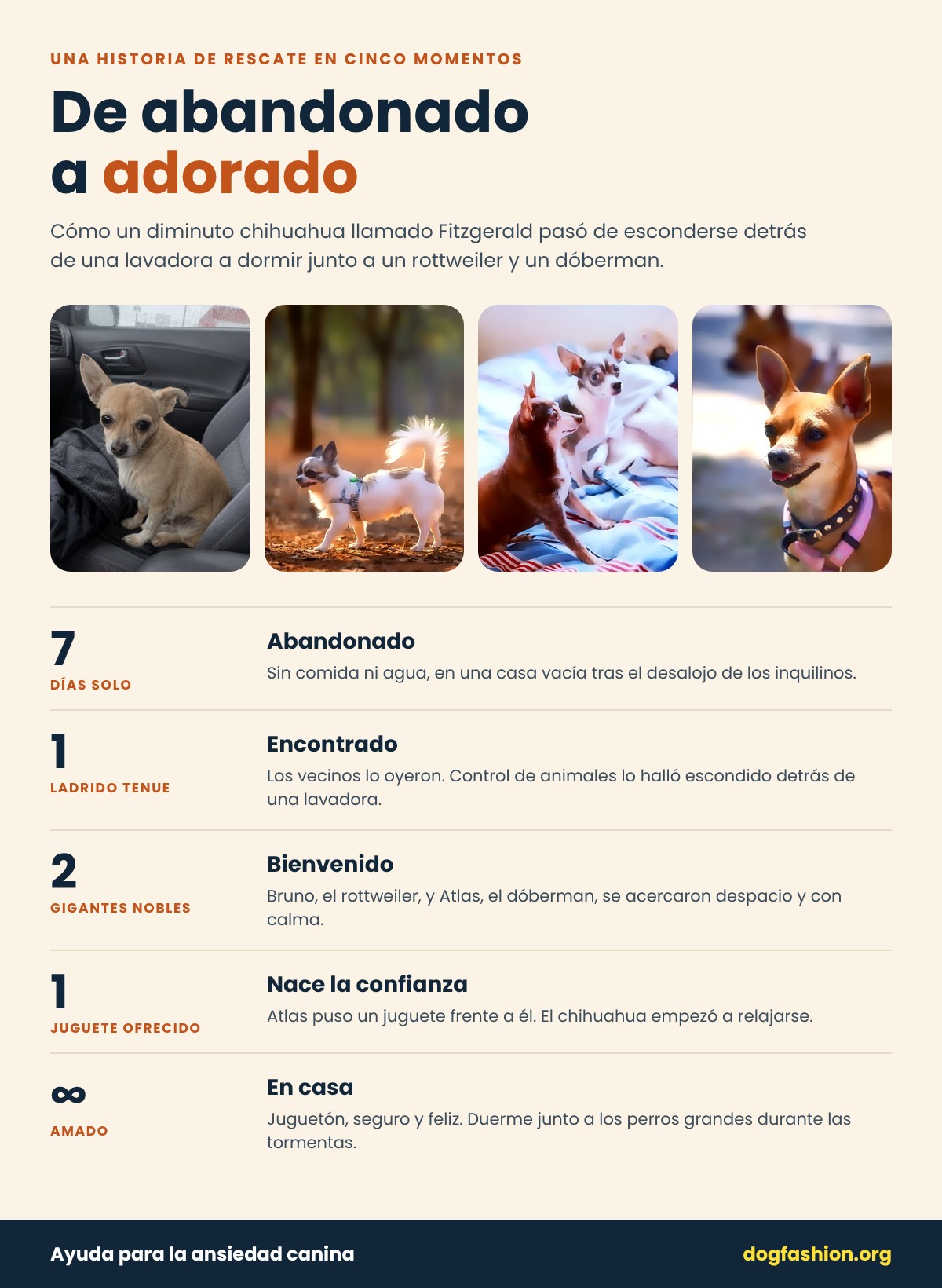
Un diminuto chihuahua fue encontrado abandonado dentro de una casa sucia y vacía tras el desalojo de los inquilinos. No tenía comida ni agua, y había pasado solo cerca de una semana. Esta es la historia de cómo ese perrito asustado se convirtió en Fitzgerald, y de los dos perros enormes que le ayudaron a sentirse seguro otra vez. También es una guía práctica sobre la ansiedad en perros rescatados: cómo se ve el miedo en un perro abandonado y qué puede hacer por él un hogar tranquilo.
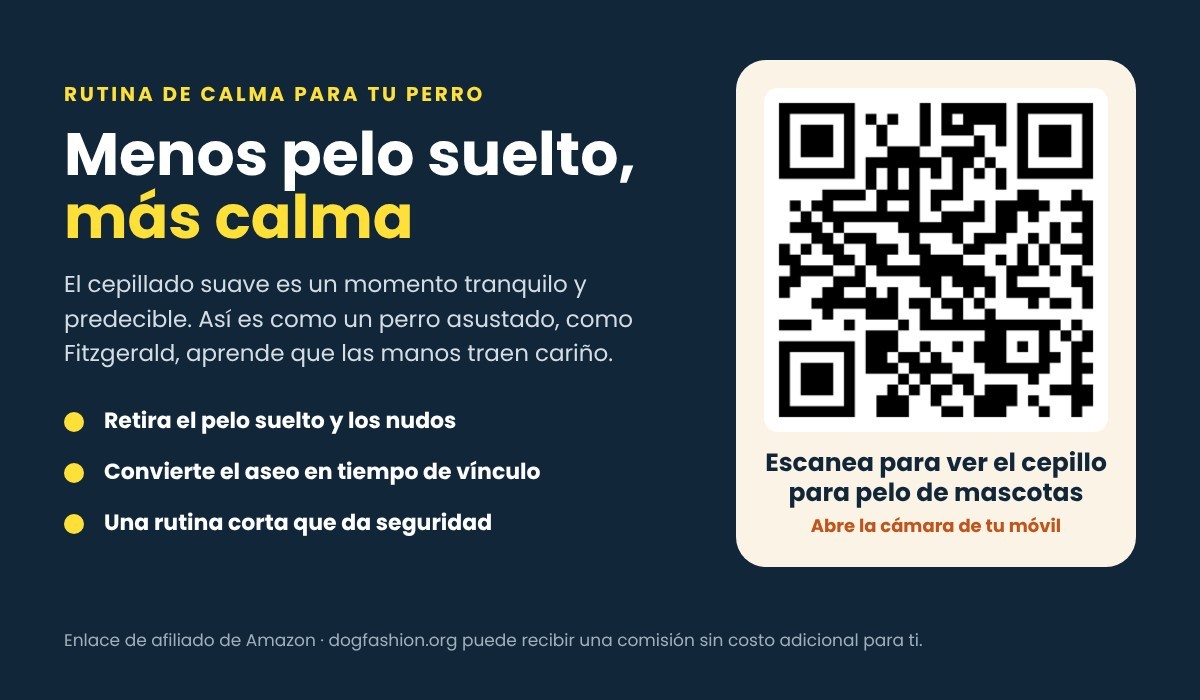
¿Tu perro también llegó a casa con miedo? Escanea el código de arriba con la cámara de tu móvil, o toca aquí para ver el cepillo para pelo de mascotas. Es un enlace de afiliado de Amazon, así que dogfashion.org puede recibir una pequeña comisión sin costo adicional para ti. Más abajo explicamos por qué el cepillado suave tiene un lugar en la rutina de calma de un perro ansioso.
Mira la historia de Fitzgerald en dos minutos
Abandonado: una semana solo en una casa vacía
Cuando desalojaron a los inquilinos, la casa quedó sin personas, pero no sin su habitante más pequeño. El chihuahua se quedó atrás, entre habitaciones sucias y vacías. Durante unos siete días no hubo nadie que llenara un plato, abriera una puerta o dijera su nombre.
Una semana es muchísimo tiempo para un perro que pesa apenas un par de kilos. Los perros pequeños tienen pocas reservas y pierden fuerzas muy rápido sin comida ni agua. Cuando por fin alguien supo que estaba allí, estaba muy débil, asustado y claramente descuidado.
El abandono después de una mudanza o un desalojo es, por desgracia, frecuente, y no depende de la raza. Ya contamos una historia parecida, la de un cachorro de pitbull blanco abandonado. Cambian los detalles, pero el patrón se repite: un perro que no hizo nada malo se queda solo de un día para otro.
Los ladridos tenues que le salvaron la vida
Fitzgerald se salvó porque los vecinos prestaron atención. Oyeron unos ladridos tenues que salían de una casa que debía estar vacía, y no los ignoraron. El servicio de control de animales acudió y revisó la propiedad.
Lo encontraron escondido detrás de una lavadora. Ese detalle importa. Un perro aterrado no corre hacia los desconocidos para pedir ayuda. Se mete en el hueco más pequeño y oscuro que encuentra y se queda ahí. Esconderse es una de las señales más claras de miedo en los perros, y suele ser lo primero que ven los rescatistas y las familias de acogida.
Si alguna vez oyes a un perro ladrar o llorar en una propiedad que crees vacía, llama al control de animales de tu zona o a una organización de rescate. No des por hecho que otra persona ya lo hizo. En esta historia, una sola llamada marcó la diferencia entre un perro encontrado y uno que no lo fue.
Un hogar de acogida con dos gigantes nobles
Una organización de rescate contactó a una familia de acogida para que se hiciera cargo de él. La familia aceptó, pero tenía una preocupación real. En casa ya vivían dos perros grandes: un rottweiler llamado Bruno y un dóberman llamado Atlas.
El chihuahua era extremadamente pequeño y frágil. Cualquiera de los dos perros grandes podía lastimarlo sin querer, solo por jugar con demasiada fuerza o pisar donde no debía. Una diferencia de tamaño así merece respeto, y la familia hizo bien en ser prudente.
Cuando llegó, estaba muy asustado y apenas se movía. No exploraba. No movía la cola. Se quedaba quieto, como hacen los perros cuando deciden que lo más seguro es volverse invisibles.
El juguete que lo cambió todo
Lo que pasó después sorprendió a todos. Los perros grandes reaccionaron con delicadeza y calma, en lugar de mostrarse agresivos. Bruno y Atlas se acercaron a él con cuidado, sin prisa, para no asustarlo.
Entonces Atlas hizo algo pequeño que significó mucho. Puso un juguete frente al chihuahua, como si le ofreciera su amistad. Nadie puede saber con certeza qué quiere decir un perro, pero el efecto fue evidente. Poco a poco, el pequeño empezó a relajarse y, por primera vez desde que lo encontraron, a mostrar confianza.
Lo llamaron Fitzgerald, un nombre elegido para reflejar su fortaleza y su capacidad de supervivencia. Es un nombre grande para un perro tan chico, y él supo estar a la altura.
Cómo presentar un perro pequeño rescatado a perros grandes
La presentación de Fitzgerald salió bien en parte por cómo son Bruno y Atlas, y en parte porque los humanos la manejaron con sensatez. Si vas a llevar un perro pequeño o nervioso a una casa con perros más grandes, estos pasos reducen el riesgo:
- Empieza con distancia. Deja que se vean y se huelan desde lejos o a través de una reja antes de compartir espacio.
- Haz encuentros cortos. Unos minutos tranquilos valen más que una hora larga y tensa.
- Observa el cuerpo del perro grande. Músculos sueltos, mirada suave y movimientos lentos son buena señal. Mirada fija o rigidez significan parar e intentarlo más tarde.
- Dale una salida al pequeño. Un transportín, una cama cubierta o un rincón cerrado donde los grandes no puedan entrar.
- Aliméntalos por separado. La comida es el motivo más común de conflicto entre perros que aún no se conocen.
- Supervisa cada interacción hasta acumular semanas de comportamiento relajado, y al principio nunca dejes solo a un perro diminuto con perros grandes.
Los perros tranquilos y equilibrados facilitan mucho este proceso. Si te interesa el temperamento de las razas grandes dentro de casa, lee nuestro artículo sobre si los labradores retriever son buenos perros para vivir dentro de casa. Y si quieres otra prueba de lo nobles que pueden ser los perros con mala fama, ahí está la historia de Daisy, la pitbull que salvó a un niño de morir congelado.
Cómo se ve la ansiedad en un perro abandonado
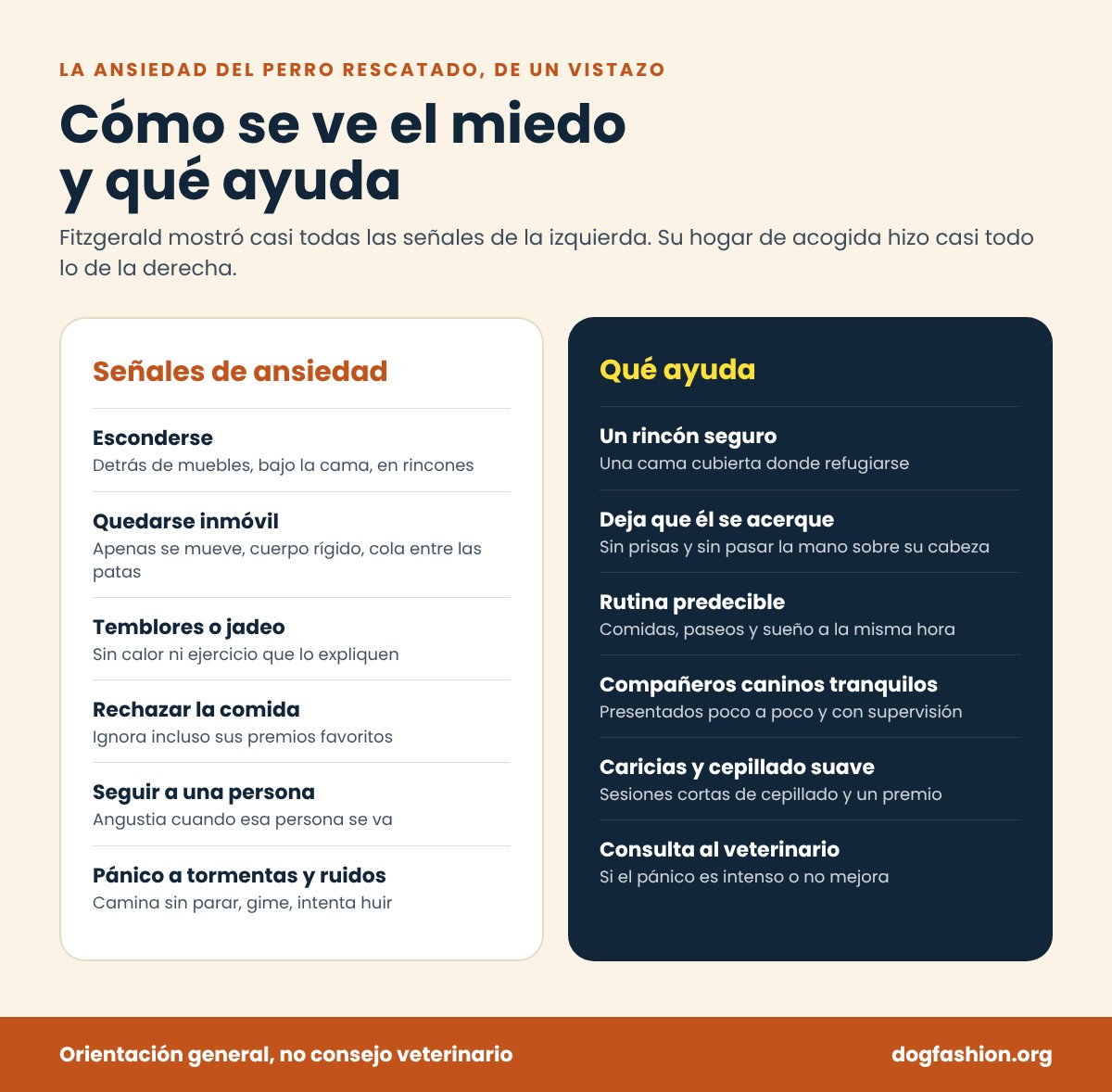
En sus primeros días, Fitzgerald mostró muchas de las señales clásicas de la ansiedad canina. Se escondía. Se quedaba inmóvil. Estaba demasiado estresado para comportarse como un perro normal y curioso. Otras señales frecuentes en perros rescatados son los temblores, el jadeo sin causa aparente, el rechazo de la comida, caminar de un lado a otro, gemir y seguir a una persona tan de cerca que cualquier separación le provoca angustia.
Nada de esto significa que el perro esté roto o que se porte mal. El miedo es información: te dice qué ha aprendido ese perro sobre el mundo hasta ahora, y con paciencia se puede desaprender. Lo explicamos con detalle (en inglés) en por qué el miedo de tu perro no es debilidad.
A veces la ansiedad se agrava. Un perro que babea, intenta escapar, se hace daño o no logra calmarse durante horas necesita algo más que un rincón tranquilo. Nuestra guía en inglés sobre las señales de que la ansiedad se está convirtiendo en pánico indica cuándo llamar al veterinario, y ante la duda esa llamada siempre es la decisión correcta.
De sombra a miembro de la familia
Con el tiempo, Fitzgerald se encariñó mucho con su nueva familia. Seguía a su cuidador a todas partes y se sentía más seguro cuando estaba cerca. A estos perros a veces se les llama «perros velcro», y es fácil entender por qué un perro al que una vez dejaron atrás quiere tener siempre a su gente a la vista.
Esa cercanía conmueve, pero puede derivar en ansiedad por separación si el perro nunca aprende que estar solo también es seguro. Lo habitual es practicar ausencias cortas y tranquilas que se alargan poco a poco. Describimos el método paso a paso, en inglés, en nuestro artículo sobre la ansiedad por separación y el entrenamiento suave.
Los perros grandes también hicieron su parte. Bruno y Atlas lo aceptaron y lo protegieron como a un miembro más de la familia. A menudo dormía con ellos, pegado a un perro muchas veces más grande que él, y buscaba su compañía para sentirse seguro durante las tormentas. Un compañero canino tranquilo puede ser un verdadero ancla para un perro nervioso, porque los perros leen el lenguaje corporal de otros perros más rápido que el nuestro. Cuando los grandes seguían relajados entre los truenos, Fitzgerald tenía la prueba viva de que no había nada que temer.
Por qué el cepillado suave forma parte de una rutina de calma
A los perros ansiosos les va mejor con rutina. Comidas a la misma hora, paseos a la misma hora y unos cuantos rituales pequeños que siempre terminan bien. El cepillado suave es uno de los rituales más fáciles de añadir, y por eso pusimos el cepillo para pelo de mascotas al principio de este artículo.
El cepillado ayuda de dos maneras. La práctica es evidente: retira el pelo suelto, evita los nudos y mantiene cómodos la piel y el pelaje, algo importante en un perro que llegó descuidado. La emocional es más silenciosa. Las pasadas lentas y predecibles le enseñan a un perro desconfiado que las manos humanas traen cariño. Para un perro como Fitzgerald, que tenía todos los motivos para desconfiar de la gente, esa lección es lo esencial.
Unas pocas reglas hacen que el aseo calme en lugar de estresar:
- Al principio, sesiones muy cortas, de uno o dos minutos, y termina antes de que el perro quiera irse.
- Empieza por donde a casi todos los perros les gusta que los toquen, los hombros y el lomo, y deja patas, cola y cara para más adelante.
- Usa poca presión, sobre todo en razas pequeñas de piel fina.
- Acompaña el cepillado con voz tranquila y termina con un premio.
- Si el perro se pone rígido, se relame o gira la cabeza, haz una pausa y vuelve a intentarlo mañana.
Si un ritual diario de cepillado te parece adecuado para tu perro, escanea el código QR que está al inicio de esta página o abre el cepillo en Amazon (enlace de afiliado). Un cepillo no es un tratamiento para la ansiedad y no sustituye al entrenamiento ni a la atención veterinaria. Es un hábito pequeño y agradable que apoya todo lo demás que ya haces por él.
La comodidad también puede venir de lo que el perro lleva puesto. La ropa suave y bien ajustada y los arneses ayudan a algunos perros nerviosos a sentirse más seguros, un tema que tratamos en Moda para perros con ansiedad: cómo vestir a tu perro puede transformar su vida.
Por qué los chihuahuas se apegan tanto
Cualquiera que haya vivido con un chihuahua reconocerá la devoción de Fitzgerald. La raza es famosa por elegir a su gente y serle ferozmente leal. Hablamos de ese lado de la raza en Los chihuahuas te amarán para siempre, y de sus raíces antiguas, en inglés, en la historia de los chihuahuas, del México prehispánico al perro faldero de hoy.
Esa lealtad explica por qué el abandono golpea tan fuerte a estos perros, y también por qué florecen de una forma tan completa cuando por fin se sienten seguros.
El perro que casi no reconocieron
La personalidad de Fitzgerald cambió gradualmente: pasó de estar asustado a mostrarse juguetón y seguro de sí mismo. Se volvió un perro lleno de energía, expresivo y con mucha personalidad, de esos perros pequeños que opinan sobre todo. Desarrolló una gran confianza en su nuevo hogar y en sus cuidadores.
Más tarde, una persona de la organización de rescate lo visitó y vio cuánto había cambiado. Aquel perro que sacaron de detrás de una lavadora, débil y callado, ahora era feliz, se sentía seguro y era profundamente amado. No hubo ningún milagro. Hubo comidas regulares, una cama caliente, humanos pacientes, dos perros nobles y tiempo.
Cómo puedes ayudar a un perro como Fitzgerald
- Avisa. Si oyes o ves a un animal en una propiedad vacía, contacta al control de animales o a un grupo de rescate local.
- Sé hogar de acogida. Las organizaciones solo pueden salvar tantos perros como hogares temporales tengan. Unas pocas semanas ya cambian una vida.
- Adopta al tímido. A los perros miedosos se les pasa por alto en los refugios, y con frecuencia son los que más cambian.
- Dona o hazte voluntario. Siempre hacen falta comida, mantas, transporte y tiempo.
- Comparte historias como esta. Recuerdan a la gente que un perro abandonado no es un caso perdido.
Preguntas frecuentes
¿Cuánto tarda un perro rescatado en adaptarse a su nuevo hogar?
Muchos rescatistas usan una guía aproximada: tres días para descomprimirse, tres semanas para aprender la rutina y tres meses para sentirse en casa. Cada perro es distinto, y uno con un pasado como el de Fitzgerald puede necesitar más.
¿Puede un chihuahua vivir seguro con un rottweiler o un dóberman?
Sí, con perros grandes tranquilos y bien socializados, presentaciones lentas y supervisión cercana. El temperamento pesa más que la raza. No dejes a un perro muy pequeño sin supervisión con perros grandes hasta que la relación esté bien establecida.
¿Cuáles son las primeras señales de ansiedad en un perro abandonado?
Esconderse, quedarse inmóvil, temblar, rechazar la comida y evitar el contacto son las más comunes al principio. Pegarse a una sola persona y entrar en pánico con tormentas o ruidos fuertes suele aparecer después.
¿De verdad el cepillado ayuda a un perro nervioso?
Las sesiones suaves y cortas pueden convertirse en una rutina que calma y ayudan al perro a acostumbrarse a que lo toquen. Apoyan el entrenamiento y la atención veterinaria, pero no los reemplazan.
¿Qué hago si encuentro un perro abandonado?
Cuida primero tu seguridad, ofrécele agua si puedes hacerlo sin acorralarlo y llama al control de animales o a una organización de rescate. Un perro asustado puede morder por miedo, así que deja la captura en manos de personas capacitadas.
Un perro pequeño, una lección grande
La historia de Fitzgerald es corta, pero dice mucho. Un vecino escuchó. Una organización hizo una llamada. Una familia de acogida dijo que sí aunque tenía dudas. Dos perros grandes eligieron la delicadeza, y un juguete en el suelo fue el primer paso hacia la confianza. Si hoy convives con un perro ansioso, quédate con eso. El avance casi nunca se nota de un día para otro, pero el miedo cede cuando el perro está a salvo, la rutina es estable y se siente querido. Esta historia también está disponible en inglés.